Việt Nam fine-tuning Extended Producer Responsibility policy to promote circular economy
Việt Nam fine-tuning Extended Producer Responsibility policy to promote circular economy
Việt Nam has gradually established an EPR framework, but further improvements are needed to make the mechanism more effective and transparent.
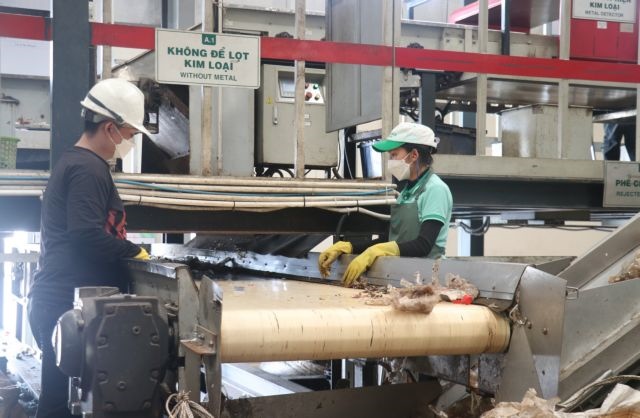
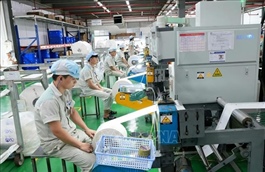
Plastic recycling plant of Duy Tân in Tây Ninh Province. — VNA/VNS Photo Bùi Giang |
Việt Nam is moving to revise its Extended Producer Responsibility (EPR) policy to strengthen the direct responsibility of producers and importers for products and packaging after use, while removing bottlenecks in collection and recycling.
The move is expected to make EPR more effective, stimulate the recycling market and promote the development of the circular economy.
EPR is regarded as an important tool for shifting from traditional waste management to a circular economic model. Instead of placing most responsibility on the State at the end of a product’s life cycle, producers and importers are required to take responsibility from the time products enter the market until they are collected and recycled after use.
Việt Nam has gradually established an EPR framework, but further improvements are needed to make the mechanism more effective and transparent. Current proposals focus on two major priorities: increasing businesses’ direct responsibility and addressing practical difficulties in implementation.
A notable change is to abolish financial contributions as a means of fulfilling recycling obligations. Under the proposal, producers and importers will be required to organise the collection and recycling of used products and packaging, either directly or through qualified organisations.
According to Tăng Thế Cương, director of the Vietnam Environment Authority under the Ministry of Agriculture and Environment, EPR should not be viewed simply as a financial obligation. More importantly, it should encourage businesses to redesign products, select appropriate materials, organise collection and recycling, and invest in circular economy solutions.
The draft allows producers and importers to choose various methods, including self-organised collection and recycling, contracting recycling companies, authorising Producer Responsibility Organisations (PROs), exporting products for recycling, or combining these approaches.
However, the shift toward direct responsibility requires stronger collection networks. To address this bottleneck, the draft proposes allowing producers, importers, PROs, recycling facilities and waste treatment establishments to establish collection points, either independently or jointly.
International experience shows that there is no one-size-fits-all EPR model. The system must reflect each country’s institutional framework, market conditions and recycling capacity.
Việt Nam’s revised EPR framework is therefore expected to build a more comprehensive ecosystem covering collection, transportation, sorting, recycling, data management and supervision, making producers’ responsibilities closely linked to actual recycling outcomes. This will help EPR become a genuine driver of the recycling market and Việt Nam’s transition toward the circular economy.
- 19:28 24/08/2026