Airlines take defensive stance as fuel and FX risks loom
Airlines take defensive stance as fuel and FX risks loom
Despite robust growth in passenger demand, local airlines are entering the second half of 2026 with cautious business plans, prioritising financial resilience as fuel costs, exchange rate risks and intensifying competition continue to squeeze profitability.
With near-unanimous approval, the 2026 AGM of Vietnam Airlines Corporation (Vietnam Airlines) on June 28 adopted a conservative production and business plan, placing the highest priority on safeguarding its financial foundation against unpredictable market volatility.
Specifically, in 2026, Vietnam Airlines aims to carry 27.73 million passengers and transport 361,400 tonnes of cargo, representing increases of 8.1 per cent and 6.2 per cent, respectively, compared with 2025.
Based on these targets, the national carrier expects consolidated revenue of approximately $5.56 billion, up 12.1 per cent on-year, while parent company revenue is projected at around $4.6 billion, an increase of 17.3 per cent over 2025.
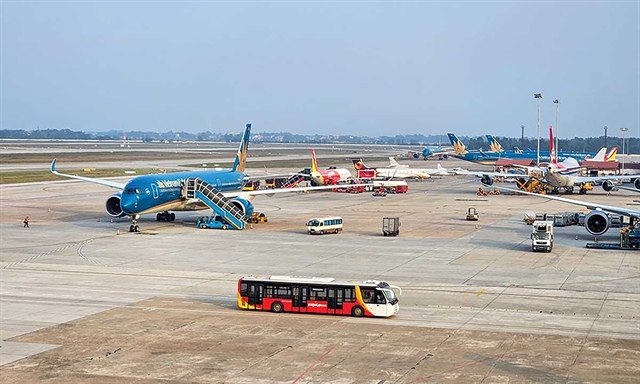
Flight operations at Noi Bai International Airport |
Regarding the broader market outlook, Vietnam Airlines forecasts that total international passenger traffic to and from Vietnam will reach approximately 46.3 million in 2026, up 12.8 per cent on-year.
Growth is expected to be driven by European markets, including Germany, Russia and Turkey, as well as Japan, India and Hong Kong (China).
The domestic market is projected to reach around 36.6 million passengers, up 6.5 per cent. Among domestic routes, Hanoi-Danang and Ho Chi Minh City-Danang are expected to record growth of 11-15 per cent, while other routes are forecast to expand by 4-10 per cent.
In fact, by early July 2026, Vietnam Airlines' forecasts had proven largely consistent with actual market developments during the first half of the year, including the peak summer travel season.
Notably, despite healthy growth in both passenger volumes and revenue, Vietnam Airlines has set a consolidated after-tax profit target of only $880,000, equivalent to less than 0.3 per cent of its 2025 result.
The parent company targets after-tax profit of approximately $4.04 million, or around 1.86 per cent of the level achieved in 2025, which marked the airline's strongest financial performance since the Covid-19 pandemic.
“The decision to formulate a conservative profit plan primarily stems from geopolitical uncertainties and aviation fuel prices. The conflict in the Middle East, together with the risk of disruptions to oil supplies through the Strait of Hormuz, has driven Jet A-1 fuel prices sharply higher,” said Tran Van Huu, chief accountant of Vietnam Airlines.
Although the airline has implemented a wide range of cost-cutting measures, optimised its route network, strengthened revenue management and imposed fuel surcharges on international routes, the sharp rise in fuel prices means these management initiatives can offset only part of the impact.
For the second half of the year, Vietnam Airlines based its business plan on an average jet fuel price of around $120 per barrel, equivalent to a full-year average of approximately $128.54 per barrel.
Under this scenario, the airline estimates that fuel costs could increase by about $524 million compared with its original business plan.
In reality, by late June and early July, jet fuel prices had fallen to around $112-$115 per barrel, below the assumptions used in Vietnam Airlines' business plan.
“Although current fuel price movements are more favourable than the assumptions underlying our business plan for the second half of the year, the fuel market still contains many unpredictable factors,” a Vietnam Airlines representative said.
In addition to fuel prices, Vietnam Airlines has identified the VND/USD exchange rate as one of its major risks in 2026, with the exchange rate expected to rise by around 3.5 per cent.
Given the nature of the aviation industry, most of the carrier’s operating expenses –including aircraft leasing, maintenance, fuel and international aviation services – are denominated in US dollars.
As a result, any appreciation of the US dollar increases operating costs while also raising the translated value of foreign currency-denominated loans and payment obligations for airlines, including Vietnam Airlines.
Vietnam Airlines is not alone. Many domestic carriers are also adopting more defensive business scenarios for the second half of 2026, prioritising cost control, cash flow preservation and operational efficiency as market risks remain elevated.
With its flexible operating model, young fleet and competitive cost structure, Vietjet is considered one of the airlines better positioned to mitigate the impact of higher fuel prices and exchange rate movements, creating greater room to improve its business performance in 2026.
Besides pressure from fuel prices and exchange rates, Vietnam's domestic aviation market is entering a more intensely competitive phase.
Following a prolonged shortage of aircraft caused by engine recalls and difficulties in leasing and purchasing aircraft, airlines have expanded their fleets since the second quarter of 2026 to capture greater market share.
This has increased total market capacity by around 20 per cent compared with the same period last year, raising the risk of excess supply in the final months of the year and further deepening the paradox of rising revenue but declining profits, with some carriers potentially facing sharp earnings deterioration.
According to the Civil Aviation Authority of Vietnam, the country's aviation market maintained solid growth momentum during the first six months of 2026, handling approximately 45 million passengers, up 8.6 per cent on-year, while cargo throughput reached around 815,000 tonnes, a strong increase of 16.6 per cent.
- 08:27 20/07/2026