Building materials sector pushed beyond raw extraction
Building materials sector pushed beyond raw extraction
Rising costs, carbon pressure and supply shortages are forcing the construction materials industry towards greener and higher-value production.
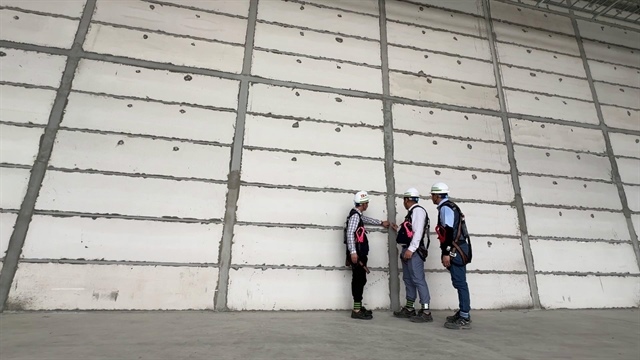
Engineers inspect lightweight autoclaved aerated concrete (ALC) wall panels at a Viglacera factory, as demand grows for greener construction materials in Việt Nam. — Photo viglacera.com.vn |
A construction boom fuelled by expressways, airports and mega urban projects is exposing growing cracks in Việt Nam’s building materials industry, where soaring prices, tightening supplies and mounting carbon pressures are forcing companies to rethink a model long built on cheap extraction and low-cost production.
The sharp rise in costs is emerging just as the Government accelerates major public investment projects, including expressways, airports and urban developments. But contractors say the bigger threat is no longer price volatility alone, but also the risk of supply shortages disrupting construction schedules.
In some localities, sand prices have risen by up to 45 per cent year-on-year, with certain areas nearing VNĐ1 million (US$38) per cubic metre. Asphalt prices have climbed nearly 32 per cent, while cement and construction stone have also recorded strong increases.
Nguyễn Quốc Hiệp, chairman of the Vietnam Association of Construction Contractors (VACC), warned that even short-term disruptions in the supply of fill materials could delay large infrastructure projects and trigger rising financing costs across the sector.
The pressure is reinforcing concerns that Việt Nam’s traditional growth model for construction materials has reached its limits.
Despite being one of the world’s largest cement producers, Việt Nam remains concentrated in low-value manufacturing. Many steel and cement plants continue to rely heavily on fossil fuels, consume large amounts of energy and generate high carbon emissions.
Economists say the industry can no longer rely on extracting and exporting raw resources while competing mainly on low costs. Instead, future growth will increasingly depend on technology, recycling capacity and carbon reduction.
The shift is also being driven by global trade pressure.
From 2026, steel and cement exporters will face growing pressure from mechanisms such as the EU’s Carbon Border Adjustment Mechanism (CBAM), which could raise costs and weaken the competitiveness of manufacturers that continue to rely on carbon-intensive production.
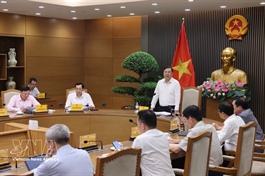
At a recent meeting on industrial development strategy, Party General Secretary and State President Tô Lâm called for the construction materials sector to move towards greener, more sustainable and technology-driven production, while reducing dependence on raw resource extraction.
Green transition
Deputy Minister of Construction Nguyễn Văn Sinh said the "greening" of the industry was no longer optional, but had become critical to the survival of many businesses.
Some major producers have already begun investing in energy-saving technologies and waste heat recovery systems. However, companies say the financial burden of transition remains severe.
Executives in the cement industry say they face growing pressure from international carbon mechanisms. Failing to decarbonise could mean losing export markets, but investing heavily in green technology without sufficient domestic policy support could weaken cash flow and profitability.
Businesses also argue that green materials still struggle to compete in the domestic market because procurement systems continue to favour traditional materials.
According to VACC chairman Hiệp, low-carbon materials often cost 15-20 per cent more, yet public bidding frameworks do not fully reflect those additional costs.
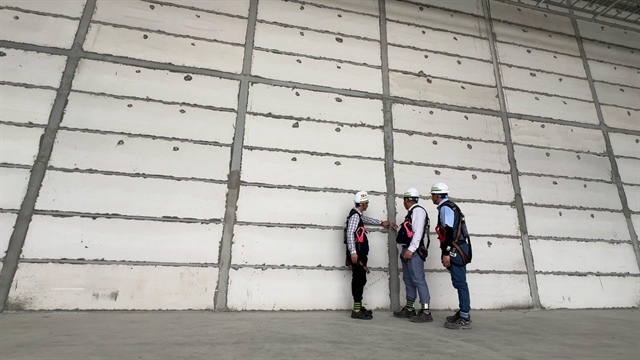
Engineers inspect lightweight autoclaved aerated concrete (ALC) wall panels at a Viglacera factory, as demand grows for greener construction materials in Việt Nam. — Photo viglacera.com.vn |
The recycling sector also remains underdeveloped.
Việt Nam generates around 9.6 million tonnes of construction waste annually, but most of it is still sent to landfills. Only 30-50 per cent of construction and industrial waste is recycled, compared with 70-90 per cent in advanced Asian economies.
Experts say the main obstacle is no longer technology, but outdated regulations and pricing systems.
Lê Trung Thành, former director of the Department of Science, Technology, Environment and Building Materials under the Ministry of Construction, said the sector needed a more coordinated policy framework.
He said policies should both secure short-term material supply for infrastructure projects and create stronger economic incentives for businesses to invest in low-carbon production.
Future materials
He argued that regulators were still “using the rules of the past to manage the materials of the future”, while standards and pricing systems for recycled materials remained underdeveloped.
Many recycled materials that meet technical standards are still excluded from public projects because of missing procurement guidelines and technical frameworks.
Some analysts have called for higher resource taxes on raw extraction to better reflect environmental costs. They argue that environmental damage linked to the mining of materials such as river sand is still not fully reflected in market prices, making recycled materials less competitive in Việt Nam.
According to industry experts, the future competitiveness of Việt Nam’s building materials sector will depend on its ability to move beyond resource-intensive production and embrace innovation-driven growth.
That shift will require stronger investment in research and development, enabling manufacturers to transform industrial waste into high-value materials for advanced applications rather than low-end construction products.
At the same time, policymakers are seeking to tackle long-standing market inefficiencies through greater price transparency and improved coordination of material supplies across regions.
Measures aimed at curbing localised price surges and lowering logistics costs could help ease pressure on producers and improve the sector’s overall efficiency.
- 07:36 06/06/2026