Vietnam moves to repeal inter-agency scrap import regulation
Vietnam moves to repeal inter-agency scrap import regulation
Vietnam’s Ministry of Finance is proposing to repeal a key inter-agency scrap import regulation as environmental rules mature, and the government pushes to simplify overlapping administrative procedures.
After more than five years, Decision No. 35/2019/QD-TTg (Decision 35) promulgating the inter-agency coordination mechanism for scrap import management is considered to have fulfilled its role during the peak period of controlling the risk of ‘waste disguised as scrap’ entering Vietnam.
However, alongside the ongoing improvement of environmental legislation, reforms in governance models and requirements for administrative procedure reform, a number of provisions have revealed shortcomings and overlaps.
On April 23, the Ministry of Finance issued Official Letter No. 5147/BTC-CHQ seeking opinions from ministries, ministerial-level agencies and relevant units on the draft Decision of the Prime Minister to repeal Decision 35.
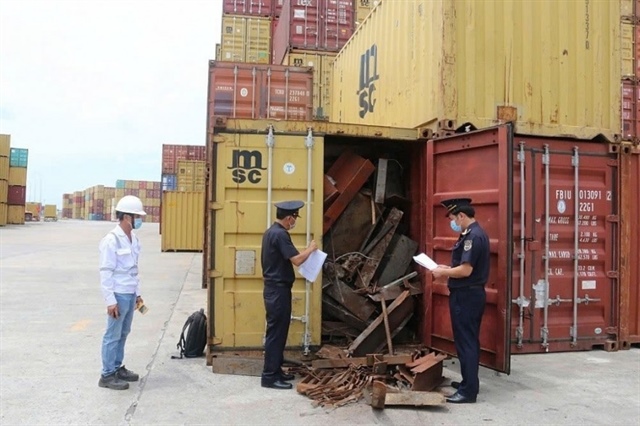
Customs officers inspect a shipment of imported scrap at a seaport |
Decision 35 was issued by the prime minister in December 2019, at a time when scrap imports into Vietnam were on steady rise, posing significant risks related to environmental pollution, smuggling and trade fraud.
At that time, many countries were tightening their scrap import policies. The shift in global scrap flows placed considerable pressure on Vietnam as the number of backlogged containers at seaports increased sharply, particularly in Haiphong and Ho Chi Minh City.
Against this backdrop, Decision 35 was viewed as an important legal instrument for establishing an inter-agency coordination mechanism in scrap import management, strengthening early and remote control measures against the risk of waste being brought into Vietnam.
During implementation of the regulation, the customs authority played a central role in organising enforcement and coordinating many key management activities.
The former General Department of Vietnam Customs, now the Department of Vietnam Customs, continuously issued guidance and directives across the sector to strengthen inspection and supervision of imported scrap shipments.
After more than five years of implementation, many provisions of Decision 35 are no longer aligned with current management practices.
One of the main reasons is that the legal framework governing environmental protection, imported scrap management and electronic administrative procedures has since been substantially revised and supplemented.
The 2020 Law on Environmental Protection, together with related decrees and circulars, has clearly stipulated the responsibilities of ministries and sectors in managing imported scrap, coordination mechanisms for inspection and examination, data-sharing requirements, information system connectivity and the implementation of administrative procedures through the National Single Window portal.
Many provisions previously stipulated separately under Decision 35 have now been codified or integrated into sector-specific legal regulations with higher legal validity.
In addition, several provisions are no longer suitable or have proven difficult to implement.
For example, the requirement for inspection agencies to upload electronic certificates to the National Single Window system has been assessed as creating unnecessary procedures, given that customs authorities are already responsible for document inspection during customs clearance.
Similarly, the provision requiring shipping lines to remove polluting backlogged scrap from Vietnamese territory has faced obstacles due to the absence of specific sanctions for non-compliance.
Furthermore, recent organisational restructuring within the customs sector and across various ministries and agencies has rendered some responsibility assignments and coordination arrangements under Decision 35 outdated.
As the government intensifies efforts to streamline and simplify administrative procedures under Resolution No. 66/NQ-CP, reviewing and eliminating overlapping and ineffective regulations has become increasingly necessary.
Based on the review of implementation, feedback from ministries, sectors and localities, as well as assessments by the State Audit Office, the MoF has proposed drafting a decision to repeal Decision 35 in its entirety.
In practice, as scrap import activities have become more stable compared with previous years, the transition from a situational management mechanism to governance based on a comprehensive sector-specific legal framework is viewed as an appropriate step in the current institutional reform process.
During the 2021-2025 period, imported scrap used as production materials totalled between 9.3 million and more than 10 million tonnes annually, with paper and metal scrap accounting for over 80 per cent of the volume. In 2024 alone, customs authorities detected and handled 43 violating declarations, the highest figure recorded during the 2021-2025 period.
According to the MoF, during the peak period of tightened control over scrap imports, Decision 35 served as a crucial legal ‘backstop’, effectively supporting inspection and enforcement efforts by customs authorities and other competent agencies.
- 16:51 12/05/2026