Rubber sector gains momentum from commodity rally and land windfall
Rubber sector gains momentum from commodity rally and land windfall
Surging natural rubber prices, improving export demand and lucrative industrial land conversion plans are combining to fuel renewed investor appetite for rubber stocks.
Since early May, natural rubber prices have climbed to their highest level in nine years, fluctuating at approximately $2,200-2,300 per tonne. The trend is creating better conditions for major rubber-exporting countries in Asia, including Vietnam.
In the first four months of 2026, Vietnam’s natural rubber exports continued to expand, while selling prices improved significantly. Rising prices and stronger consumption demand have quickly translated into positive business results for many companies in the sector.
Business operations at numerous natural rubber enterprises have also shown clear improvement. At Tan Bien Rubber JSC, first-quarter revenue exceeded $20.9 million, up 135 per cent on-year, while after-tax profit reached more than $9.1 million, up 209 per cent.
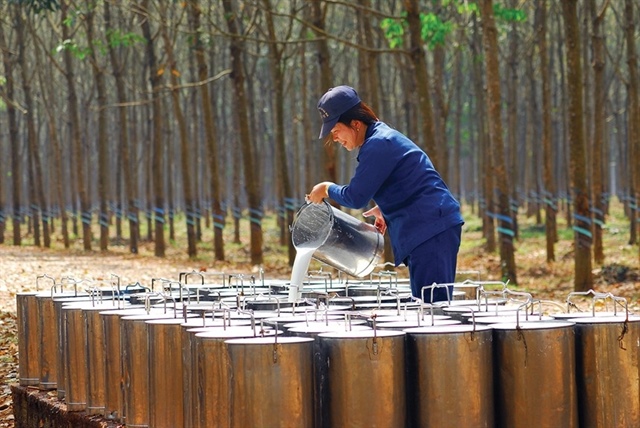
The natural rubber prices are hovering at high levels in recent months |
Vietnam Rubber Group currently owns around 377,797 hectares of rubber plantations. In Q1, the group recorded revenue of $353.8 million, up 56 per cent on-year, while profit surged 89 per cent to nearly $118.4 million.
The main growth driver came from stronger global rubber demand, particularly from the automotive and tyre manufacturing industries in China, the world’s largest rubber-consuming market.
Phuoc Hoa Rubber JSC also posted strong momentum in Q1, with revenue reaching $18.7 million, up 50.3 per cent on-year. Vietcombank Securities (VCBS) forecasts that Phuoc Hoa Rubber’s rubber segment revenue could reach around $69.8 million in 2026.
For Phuoc Hoa Rubber specifically, VCBS believes plantation productivity will continue to improve after the company completed the replanting of all ageing rubber trees, while many newly planted areas are entering a stable harvesting phase.
In addition, the company’s approximately 7,664 ha of rubber plantations in Cambodia are moving into the peak-yield stage of the crop cycle.
The favourable movement in rubber prices, together with expectations of stronger profit growth, has quickly attracted investor attention in the stock market.
Recently, shares of diverse rubber companies such as TRC, PHR and HRC have recorded strong gains. Notably, HRC shares hit the daily ceiling for four consecutive sessions from May 7 to 12.
Investors believe rubber stocks are entering a favourable phase, supported simultaneously by the commodity price upcycle and expectations of improving core business performance.
This marks an important distinction from previous periods, when many companies in the sector were valued mainly for their ‘land bank story’.
Phuoc Hoa Rubber has drawn considerable market attention as one of Vietnam’s largest natural rubber producers, with its land bank concentrated primarily in Binh Duong area (now part of Ho Chi Minh City).
The company plans to convert more than 3,000 ha of rubber land into industrial park developments, while also expanding into supporting sectors such as residential property, renewable energy and high-tech agriculture.
Meanwhile, shares of Tay Ninh Rubber JSC are viewed by An Binh Securities (ABS) as having positive sales volume prospects thanks to the recovery of the automotive and tyre manufacturing industries in major markets such as China and India.
The expansion of Vietnam’s electric vehicle ecosystem, particularly through cooperation between Vingroup and Vinachem to develop a materials supply chain for VinFast, could indirectly support long-term domestic rubber demand through increased local tyre production.
Beyond benefiting from the upcycle in natural rubber prices, many companies also possess a “dual-growth story,” combining expansion potential in their core businesses with the prospect of strong profits from industrial land assets.
According to VCBS forecasts, Phuoc Hoa Rubber alone could record around $28 million in profit from compensation related to rubber land conversion in 2026. Notably, the Bac Tan Uyen Industrial Park is expected to generate approximately $80-120 million in land conversion compensation for the company.
Tay Ninh Rubber also has the potential to deliver exceptional profit growth in 2026. The company plans to convert around 495 ha of rubber land at the Go Dau plantation – mainly ageing or low-yield plantations – to support the development of the Hiep Thanh Industrial Park.
The venture broke ground in December 2025. Under the plan, the 2025-2026 will focus on infrastructure deployment and completion of land-use conversion procedures, paving the way for Tay Ninh Rubber to recognise extraordinary income of around $78.4 million from land compensation and plantation liquidation.
Against the backdrop of persistently high natural rubber prices, improving harvesting and export activities, and the industrial park segment continuing to generate substantial revenue, rubber companies are considered to possess multiple supportive factors for medium- and long-term profit growth.
This partly explains why capital flows in the stock market are returning to rubber stocks after a relatively subdued trading period.
- 17:36 20/05/2026