Rice export value falls despite steady volumes in Q1
Rice export value falls despite steady volumes in Q1
Falling prices dragged down Việt Nam’s rice export value in early 2026 despite steady volumes, as the sector shifts towards higher quality and greener production.
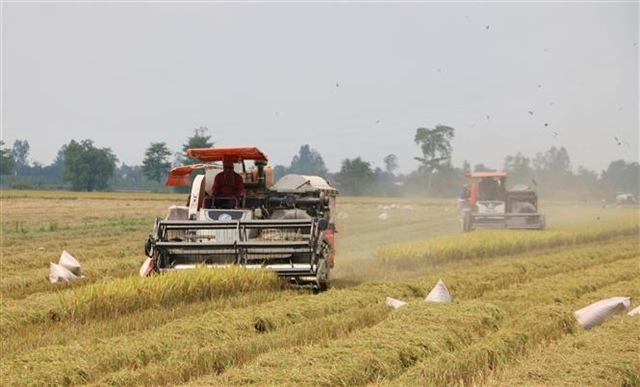
Farmers in Thoại Sơn District, An Giang Province, harvest the 2025 Winter–Spring rice crop. — VNA/VNS Photo Công Mạo |
Rice export earnings fell in the first quarter of 2026, as weaker prices offset stable shipment volumes amid intensifying global competition.
In the first three months, rice exports reached 2.3 million tonnes, up 0.2 per cent year-on-year. However, export value dropped 7.8 per cent to US$1.1 billion, reflecting a sharp decline in average prices.
March shipments were estimated at one million tonnes, worth US$516.5 million. The average export price fell to about $480 per tonne, down 8 per cent, as global supply remained abundant.
The Philippines remained the largest buyer, accounting for 52.6 per cent of total exports and posting steady growth. China stood out, with export value rising 2.5 times, while traditional markets such as Ghana and Côte d’Ivoire recorded sharp declines, signalling a more polarised market structure.
At home, paddy prices in the Mekong Delta moved in different directions in March. Fresh paddy prices fell due to ample supply during the peak Winter–Spring harvest, while dried paddy and higher-quality rice edged up. The trend points to a gradual shift towards higher-value segments rather than volume-driven growth.
Globally, rice prices stayed under pressure as India and Thailand lowered export prices. Vietnamese rice remained relatively stable, but rising freight costs – especially on long-haul routes to Africa – continued to squeeze exporters’ margins.
Focus on restructuring
Việt Nam’s rice sector is pivoting from volume-driven growth to higher value, with a stronger focus on quality, supply chain restructuring and emissions reduction.
The 2026 target keeps exports at 7–7.5 million tonnes while aiming to raise value to $4.5–5 billion.
Deputy Minister of Agriculture and Environment Phùng Đức Tiến said the sector is accelerating the use of science, technology and digital tools, with up to 89 per cent of cultivated areas already using high-quality varieties, though further improvements are needed as competition intensifies.
Research programmes are focusing on short-duration, high-yield varieties that can better adapt to climate change. At the same time, efforts are under way to build sector-wide databases, expand digital tools and scale up low-emission farming models.
A one-million-hectare programme for high-quality, low-emission rice is central to the shift, alongside stricter production standards and certification to strengthen credibility in global markets.
The Ministry of Industry and Trade has called for closer coordination between export management and domestic market stability, while pushing market diversification, trade promotion and stricter quality control.
As competition shifts towards quality, sustainability and traceability, restructuring is seen as essential to sustaining export value. The agriculture sector has shown resilience, posting growth of 3.58 per cent in the first quarter with export turnover reaching $16.7 billion, suggesting further gains are possible if the transition is effectively carried out.
- 15:19 10/04/2026