"Green passport” seen as key to global market access for Việt Nam’s F&B firms
"Green passport” seen as key to global market access for Việt Nam’s F&B firms
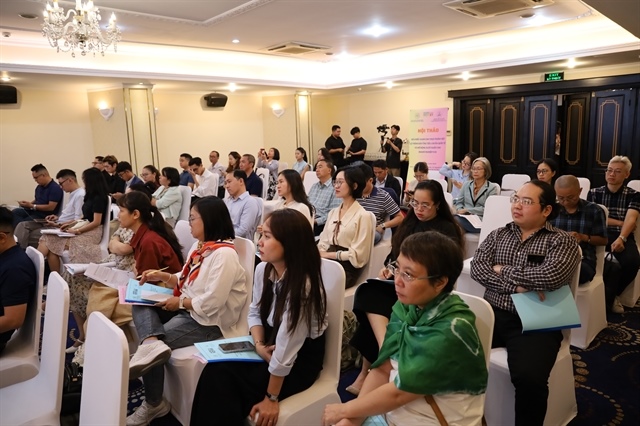
With green standards and sustainability requirements increasingly becoming a “passport” to access global markets, Vietnamese F&B enterprises face an urgent need for comprehensive transformation to enhance competitiveness and expand exports, experts said at a seminar in HCM City on April 10.
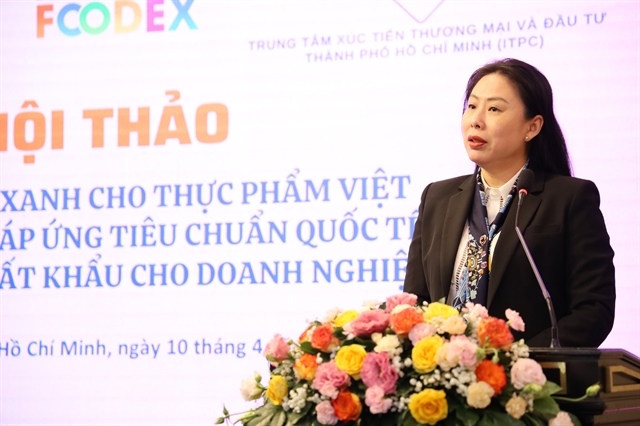
Hồ Thị Quyên, deputy director of the Investment and Trade Promotion Centre of HCM City, speaks at a seminar in HCM City on April 10. — Photo courtesy of ITPC |
With green standards and sustainability requirements increasingly becoming a “passport” to access global markets, Vietnamese F&B enterprises face an urgent need for comprehensive transformation to enhance competitiveness and expand exports, experts said at a seminar in HCM City on Friday.
At the seminar titled “Green Passport for Vietnamese Food – A Roadmap to Meet International Standards and Expand Export Markets for F&B Enterprises,” co-organised by the Investment and Trade Promotion Centre of HCM City (ITPC) and the Global Intellectual Business Association (GIBA), speakers outlined strategies to help businesses shift from low-cost competition to sustainable value creation.
In her opening remarks, Hồ Thị Quyên, deputy director of ITPC, said 2026 marks a turning point as green standards, transparency and accountability become prerequisites for entering international markets.
Citing international reports, Quyên noted that the global healthy food market is projected to exceed US$860 billion by 2026, growing at over 10 per cent annually. At the same time, major export markets such as the EU, the US and Japan are tightening regulations related to food safety, traceability, packaging and emissions across supply chains.
She said F&B businesses are facing mounting pressures from three directions.
First is consumer demand. Buyers are no longer focused solely on price or taste, but increasingly prioritise health, nutrition and product safety. Products with clear origins and strict quality control are becoming the market norm.
Second is pressure from distribution systems and international partners. Many major retailers in Europe and the US have integrated environmental, sustainability and social responsibility criteria into their supplier selection processes. More than 70 per cent of global consumers are willing to pay a premium for environmentally friendly products, prompting distributors to raise their standards.
Third is pressure from policies and regulations. Export markets are shifting from voluntary incentives to mandatory requirements, particularly in traceability, labelling and emissions control. Businesses must not only meet these standards but also demonstrate compliance in a transparent and consistent manner.
Together, these forces are reshaping global benchmarks for the food industry, she said.
“In this context, Vietnamese enterprises have an opportunity to reposition themselves within global value chains. Việt Nam’s agro-forestry-fishery exports have surpassed US$50 billion annually, making the country one of the world’s leading exporters,” she added.
“Today’s international partners are no longer seeking the lowest-cost suppliers. Instead, they prioritise businesses that demonstrate operational reliability, transparency and a willingness to innovate. This creates an opportunity for Vietnamese enterprises to shift from price-based competition to competing on quality, value and credibility,” she said.
Hoàng Văn Việt, chairman of GIBA and lecturer at the University of Economics HCM City, said food consumption is evolving alongside changing consumer values.
“Food is no longer just about eating well or even eating safely, it is increasingly about eating responsibly,” he said.
Hồ Thị Quyên, deputy director of the Investment and Trade Promotion Centre of HCM City, speaks at a seminar in HCM City on April 10. — Photo courtesy of ITPC |
Việt Nam’s agro-forestry-fishery exports have surged from $41 billion in 2020 to more than $62 billion in 2024, highlighting the country’s strong production and export capacity.
However, he noted that while export volumes are high, the value-added proportion of Vietnamese products remains below potential due to persistent structural weaknesses, including difficulties in meeting international standards, limited control systems and weak traceability capabilities.
He emphasised that, beyond producing “good products”, businesses must invest in building “good systems” that enhance transparency and meet global requirements.
He also emphasised that there is no single “best” certification, only those that align with each company’s development strategy and target markets. Certification is not merely an administrative requirement, but a system of trust that validates products and enhances their value in international markets.
From an international perspective, Liney Weishappel, CEO and co-founder of AllMadeViet, said green standards are no longer voluntary but mandatory for businesses seeking to enter major markets such as the EU, the US and Japan.
To improve competitiveness and transition from low-cost suppliers into reliable strategic partners, she recommended that businesses strengthen their production systems based on four core pillars: quality and safety assurance, traceability and transparency, environmental management, and social responsibility compliance.
She also outlined a roadmap for Vietnamese manufacturers to adopt green standards, including identifying target markets, standardising requirements, assessing current capabilities, prioritising resources for key standards, implementing cost-optimised solutions, and enhancing collaboration with professional organisations.
Experts also stressed that beyond technical improvements, a fundamental shift in leadership mindset is required. Businesses must move away from short-term, price-based competition toward building long-term partnerships grounded in trust and value. Actively engaging in trade promotion activities and leveraging support from government agencies and industry associations will also help translate compliance with green standards into tangible export opportunities.
The seminar was the third in a series of five events held within the framework of the 5th Ho Chi Minh City International Food and Beverage Exhibition 2026 (HCMC FOODEX 2026), aimed at updating businesses on green transformation trends and sustainability requirements in key export markets.
- 05:10 13/04/2026