Enterprises ready for ESG
Enterprises ready for ESG
Eco and Environmental, Social, and Governance are essential requirements for Vietnamese enterprises to integrate into global value chains, experts revealed at the seminar “Economic Outlook 2026: FDI Businesses and the Roadmap for Vietnam’s Rise” held in Ho Chi Minh City on April 2.
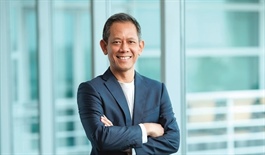
Dr. Jackson Woo, managing director of SGS Vietnam, noted that beyond price and delivery schedules, companies are now expected to meet rigorous requirements on product quality and safety, comply with environmental and emissions standards, uphold social responsibility and environmental, social, and governance (ESG) commitments, and ensure transparency and end-to-end traceability across the supply chain.
“Notably, mechanisms such as the EU Carbon Border Adjustment Mechanism, set for full implementation from 2026, are expected to exert substantial pressure on Vietnam’s major export sectors, including steel, cement, aluminium, and fertilisers. Standards are no longer a source of competitive advantage, but a baseline requirement for market entry,” Woo said. “Global certifications and standards are becoming increasingly essential for businesses. Companies need a well-defined, step-by-step roadmap to strengthen their capabilities and meet global requirements.”
The rise of integrated eco-industrial parks, increasingly viewed as a new infrastructure foundation for attracting high quality FDI.
Truong Khac Nguyen Minh, deputy general director, Prodezi Long An Corporation, said highlighted a model structured around four tightly integrated pillars.
The sustainable technical infrastructure must be designed from the outset to optimise resource use and minimise emissions, including energy-efficient systems, closed-loop water cycles, and solutions that convert waste into valuable resources.
In industrial symbiosis where companies within the same industrial park are interconnected to exchange resources, reuse by-products, and build internal supply chains, thereby reducing costs and overall emissions.
In addition, integrated service ecosystem is offering support throughout the project lifecycle, from legal and construction to operations, while helping businesses meet ESG requirements, standardise partners, and reduce implementation risks.
Finally, digital infrastructure and data governance enable real-time operational monitoring, data integration and standardisation, and support ESG reporting meeting the growing transparency demands of international partners.
“Overall, this model positions industrial parks not merely as providers of production space, but as platforms that systematically and efficiently support businesses in meeting global standards. It helps companies shorten project implementation timelines, reduce compliance costs, and enhance their ability to meet international requirements, factors that are increasingly critical for accessing markets such as the EU,” said Minh.
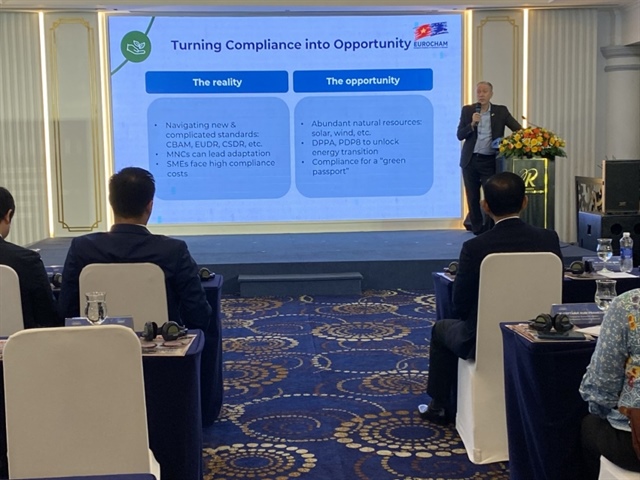
André de Jong, board member of EuroCham Vietnam, highlighted findings from the Business Confidence Index (BCI) report |
Talking about confidence of the foreign investors into the Vietnamese market amid global uncertainty, André de Jong, board member of EuroCham Vietnam, highlighted findings from the Business Confidence Index (BCI) report, noting that 2025 marked a pivotal shift in the outlook of European businesses in Vietnam.
According to the survey, the BCI in the fourth quarter of 2025 reached 80 points, up 29 per cent, and the highest level in seven years.
Jong said that the results signalled a strong rebound in business confidence. “In a world of structural uncertainty, Vietnam offers what investors value most: predictability. Notably, 88 per cent of European businesses expressed optimism about the outlook over the next five years,” Jong said. “Amid geopolitical shocks, trade tensions, and the ongoing restructuring of global supply chains, Vietnam has emerged as a “low-risk environment in a high-risk world,” a fundamental source of competitive advantage.”
Vietnam holds a strategic position in the supply chain diversification plans of European companies.
According to EuroCham, the country has established 17 free trade agreements and 15 comprehensive strategic partnerships, creating a broad and deeply integrated network with major global economic centres. At the same time, GDP growth of 8.46 per cent in the fourth quarter of 2025, the strongest in nearly two decades, has strengthened investor confidence in Vietnam’s long-term growth.
However, Vietnam’s competitive advantages are evolving. Whereas low labour costs, land access, and tax incentives once played a decisive role in attracting foreign investment, investors today place greater emphasis on adherence to international standards, along with transparency and sustainability.
Economist Dr. Huynh Thanh Dien noted that 2026 would bring new opportunities as several key trade agreements fully come into effect. However, requirements on environmental standards, labour, and rules of origin are expected to become more stringent in line with existing commitments.
“The real challenge lies in the ability to meet these standards. Companies that fall short on governance, environmental performance, and social responsibility face a real risk of being excluded from global supply chains. At the same time, Vietnam’s participation in more than 17 trade agreements has opened up vast opportunities, but these will not last forever. Businesses that move too slowly are likely to be disadvantaged as requirements become increasingly stringent,” Dien said.
Vietnam is moving into a new stage of development where investment quality outweighs quantity, and compliance with global standards becomes a core benchmark of competitiveness.
FDI companies are no longer just seeking a manufacturing base but are increasingly seeing Vietnam as a long-term strategic partner in building value chains that are sustainable, transparent, and resilient to global shocks.
- 14:32 02/04/2026