Conference discusses measures to boost roles of economic groups
Conference discusses measures to boost roles of economic groups
Việt Nam needs to foster a new generation of private enterprises with stronger technological capabilities to lead key industries and shift from supporting growth to driving the country’s modernisation.
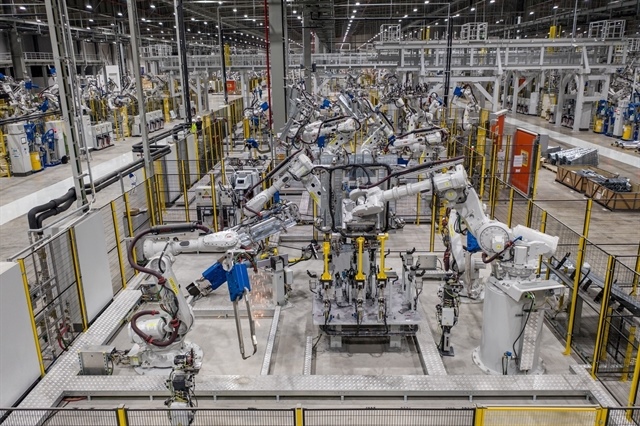
An automobile production line of VinFast. Việt Nam needs to develop policies to remove bottlenecks and unlock resources to strengthen the role of the economic groups in driving the country’s rapid and sustainable growth. — VNA/VNS |
Việt Nam needs to develop policies to remove bottlenecks and unlock resources to strengthen the role of economic groups in driving the country’s rapid and sustainable growth, a conference on Monday was told.
Organised by Nhà Đầu Tư (The Investor) magazine, the event provided a platform for policymakers, experts and the business community to review the 40-year journey of Đổi mới (Renewal) and assess the leading role of economic groups.
The Politburo has issued a series of strategic resolutions, including Resolution No. 57 on science and technology, innovation and digital transformation, Resolution No. 68 on promoting the private sector and Resolution No. 79 on developing the State economy.
These all share a common goal of building leading economic groups capable of expanding regionally and globally, playing a pivotal role in guiding, promoting, and supporting small and medium-sized enterprises (SMEs), and strengthening the internal capacity of the economy.
However, participants stressed that more concrete policies are needed to bring these resolutions into practice.
According to Nguyễn Đức Hiển, deputy head of the Communist Party of Việt Nam Central Committee's Commission for Policies and Strategies, the private sector currently contributes around 50 per cent of GDP and plays a key role in job creation, with over one million enterprises and five million household businesses.
However, the economy still lacks strong private conglomerates capable of leading development.
Hiển emphasised the need to finalise institutional frameworks to unlock private resources, noting that Việt Nam is projected to require around VNĐ38.5 quadrillion (US$41.46 trillion) in total investment over the next five years, of which about VNĐ8.51 quadrillion will come from the State budget, with the remainder expected from the private sector and foreign investors.
Another key issue is how to strengthen linkages among State-owned enterprises, private enterprises and foreign-invested enterprises, as well as what policy mechanisms are needed to build a unified and integrated business ecosystem.
The role of foreign-invested enterprises and how they should be linked with domestic firms needed to be redefined as Việt Nam seeks to enhance economic self-reliance, Hiển said.
Đậu Anh Tuấn, Deputy General Secretary of the Vietnam Chamber of Commerce and Industry (VCCI), said that after nearly 40 years of Đổi Mới, the private sector had evolved from having little legal recognition to becoming one of the most important drivers of the national economy as Việt Nam rose to 32nd globally by GDP and into the world’s top 15 in trade in 2025.
However, Tuấn noted persistent structural weaknesses, including limited integration into global value chains and a heavy concentration in finance and real estate, which account for about half of major private sector activity.
Most businesses remained small, with around 70 per cent employing fewer than 10 workers, while productivity and industrial capacity remain constrained, he said.
“Việt Nam needs to foster a new generation of private enterprises with stronger technological capabilities to lead key industries and shift from supporting growth to driving the country’s modernisation,” Tuấn stressed.

An automobile production line of VinFast. Việt Nam needs to develop policies to remove bottlenecks and unlock resources to strengthen the role of the economic groups in driving the country’s rapid and sustainable growth. — VNA/VNS |
Nguyễn Quang Thuận, chairman of FiinGroup, said the country was entering a new phase with large capital demand, but the key challenge was not only how to raise fund but also how to use them efficiently.
“The important question now is how to ensure each unit of capital generates greater value,” he said, warning that this will determine the position of Việt Nam’s economic groups in the coming decades.
He noted that while Việt Nam maintained strong GDP growth, this had not translated evenly into revenue growth for domestic enterprises.
He highlighted the need for policies to develop large-scale competitive local firms.
Stressing that bank credit alone would not be sufficient to meet financing demand, Thuận said it was necessary to expand medium- and long-term capital sources, improve project bankability and accelerate capital market reforms, including the corporate bond market.
He also called for efforts to raise the country’s sovereign credit rating before 2030 together with promoting new financial instruments such as infrastructure securitisation, and establishing national investment funds to support long-term growth.
Economist Trần Đình Thiên said that building strong economic groups would be essential for Việt Nam to become a major economic power, noting that modern economies operate through value chains led by large corporations.
He said Việt Nam needed powerful private conglomerates capable of competing globally and eventually becoming multinational corporations, adding that policy support should be more targeted rather than spread across sectors.
Thiên also highlighted the need to strengthen linkages between leading firms and smaller enterprises, particularly in key industries such as automotive manufacturing, where anchor companies can drive the development of entire supply chains.
Bùi Thanh Minh, Deputy Director at the Private Economic Development Research Board said the country must align enterprise development with its broader national strategy, identifying key industries where domestic firms can take the lead, including railway infrastructure, electric vehicles, renewable energy and emerging technologies such as artificial intelligence and semiconductors.
Việt Nam had only four companies ranked among Southeast Asia’s top 50, highlighting the limited scale of domestic enterprises despite decades of reform, he said.
“The first wave of Đổi Mới helped lift the country out of poverty by unlocking labour resources," Minh said.
"The next phase of reform should focus on unlocking innovation and technological capacity, rather than relying solely on labour and capital expansion.”
- 09:52 14/04/2026