Việt Nam’s wood industry strives to enhance export value
Việt Nam’s wood industry strives to enhance export value
Vietnamese wood and interior products are now present in more than 160 countries and territories, with the US market alone making up over half of the sector’s total export value.
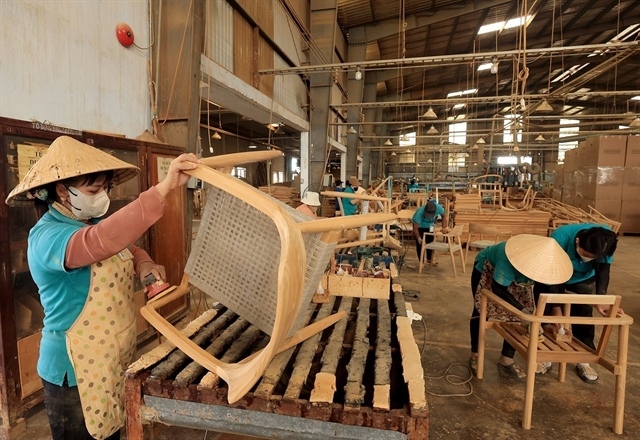
A wood processing line at Hiệp Long Fine Furniture Company in HCM City for exports. The wood sector is under pressure to accelerate its transition toward greener production and emission reductions in line with global sustainable trade trends. — VNA/VNS Photo |
Việt Nam’s wood processing industry is stepping up efforts to enhance its export value by investing in technology, green production, and product design while diversifying markets to strengthen competitiveness in the global market.
According to Director of the Việt Nam Trade Promotion Agency under the Ministry of Industry and Trade Vũ Bá Phú, the wood sector remains one of Việt Nam’s key export industries in 2025, with export turnover of timber and wood products reaching about US$17.2 billion.
HCM City accounted for a major share of the total, with a turnover of over $9 billion. Vietnamese wood and interior products are now present in more than 160 countries and territories, with the US market alone making up over half of the sector’s total export value.
However, the industry is also facing multiple challenges. Major markets such as the European Union and the US are imposing increasingly stringent requirements on product quality, traceability, and sustainable development.
In addition, the sector is under pressure to accelerate its transition toward greener production and emission reductions in line with global sustainable trade trends. Changes in tariff policies, particularly from the US, are also affecting competitiveness, while rising geopolitical risks are disrupting supply chains, pushing logistics costs higher.
According to Vice Chairman of the Handicraft and Wood Industry Association of HCM City (HAWA) Tô Ngọc Ngời, these challenges require the industry to strengthen forecasting capacity, risk management, and adaptability.
Wood-processing enterprises in HCM City have proactively reformed their operations by optimising production and business processes, investing in advanced machinery and technology, and tightening the management of legally sourced timber supply chains. They are also accelerating digital transformation in governance and trade promotion while adopting energy-saving and environmentally friendly production solutions.
Businesses are also seeking ways to reduce production costs to enhance competitiveness. Phùng Quốc Cường, production director of Bảo Hưng Co Ltd, said his company has partnered with two suppliers to introduce new packaging solutions that help “green” the packaging process.
The new packaging reduces product box size, minimises damage during transportation, and cuts packaging costs by 20–30 per cent, helping the company’s products compete more effectively in the US market.
Meanwhile, CEO of Viet Goods Import-Export JSC Nguyễn Văn Sang said enterprises must pay greater attention to product design and comply with environmental, social and governance (ESG) standards to increase export value and competitiveness.
Ngời emphasised that to move beyond simple outsourcing and production based solely on orders, Vietnamese wood enterprises need to invest more strongly in design and product development to raise added value.
Experts noted that Vietnamese workers possess high craftsmanship and can produce highly personalised products, which is becoming a new global consumer trend. Combined with modern design and certified raw materials, Việt Nam’s wood industry has the potential to create high-value products that can compete strongly in international markets.
According to Deputy Minister of the Ministry of Agriculture and Environment Nguyễn Quốc Trị, the ministry is committed to supporting wood enterprises through several strategic pillars. These include improving the institutional framework to create favourable conditions for sustainable development, ensuring legal timber supplies through the development of domestic raw material zones and sustainable forest certification, and helping businesses improve their capacity to comply with international trade defence measures and technical environmental standards.
Meanwhile, Chairman of the HCM City People’s Committee Nguyễn Văn Được has called on HAWA and the city’s wood industry to pursue five strategic goals, including leading the shift toward green production; enhancing design, technology and branding to move from “Made in Vietnam” to “Made by Vietnam”; strengthening supply chain transparency through technology; diversifying export markets to regions such as the Middle East, South Asia and Latin America; and contributing to the city’s target of achieving double-digit economic growth in 2026.
- 15:23 16/03/2026