Rising costs squeeze farm cooperatives, threaten competitiveness
Rising costs squeeze farm cooperatives, threaten competitiveness
Cooperatives account for roughly 65-70 per cent of rice, vegetables and fruit supplied to the domestic market and play a key role in exports.
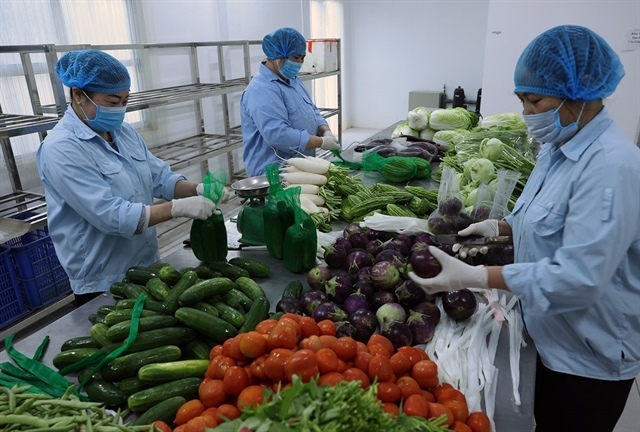
Fruits and vegetables are packed at a cooperative in Hà Nội. — VNA/VNS Photos |
Agricultural cooperatives in Việt Nam are coming under mounting pressure as rising input and logistics costs eat into margins, weaken competitiveness and expose structural inefficiencies across the supply chain.
Cooperatives account for roughly 65–70 per cent of rice, vegetables and fruit supplied to the domestic market and play a key role in exports, according to the Vietnam Cooperative Alliance.
However, industry participants say many cooperatives remain focused on output rather than profitability, leaving them vulnerable to rising input costs and market volatility.
Nguyễn Thị Thành Thực, CEO of the Hà Nội-based AutoAgri Software Technology JSC, said high production costs remain a major concern.
She cited chilli peppers as an example of price disparities along the supply chain. Farm-gate prices stand at about VNĐ20,000 (US$0.80) per kilo, rising to around VNĐ40,000 at the cooperative level and exceeding VNĐ100,000 on supermarket shelves.
The gap reflects added costs such as transport, storage, packaging and spoilage, but also highlights inefficiencies that limit profits for farmers and cooperative members, she told vnbusiness.vn.
Beyond supply chain costs, global pressures are adding to the burden.
The Ministry of Agriculture and Environment said urea fertiliser prices have climbed to about $540–$545 per tonne, contributing to a 3–5 per cent increase in overall production costs.
Meanwhile, ongoing conflict in the Middle East is expected to push sea freight rates up by 25–35 per cent and extend shipping times by up to two weeks.
According to Lê Văn Tám, director of Song Hong agricultural cooperative in Hà Nội, high costs and intermediary mark-ups are making cooperative products less competitive.
He added that when prices are pushed too high, his cooperative’s goods struggle to reach consumers.
Processing push seen as key to boosting profits
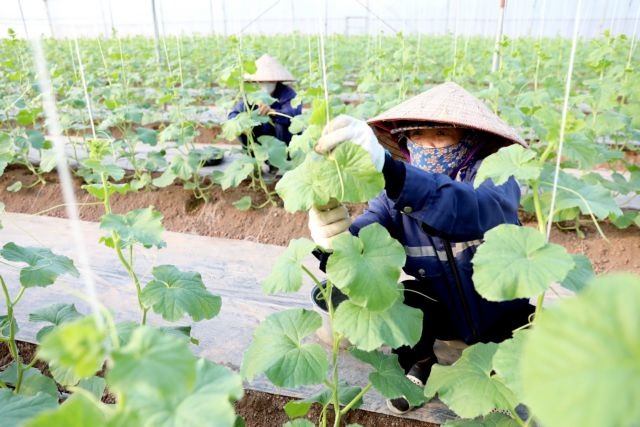
Fruits and vegetables are packed at a cooperative in Hà Nội. — VNA/VNS Photos |
To address these challenges, experts say cooperatives must manage costs more carefully and rethink their production models.
Thực from AutoAgri Software Technology JSC said production costs should be strictly controlled and kept below 20 per cent of total investment to ensure profitability.
If input costs such as feed, fertilisers and seeds account for 50–60 per cent of total production costs, profits become difficult to achieve, Thực said.
She also highlighted production density as a commonly overlooked factor. While some cooperatives have increased utilisation rates to around 80 per cent, many others still operate at only about 5 per cent density for crops and vegetables, raising costs and limiting output.
Higher planting density could increase yields per unit area, enable larger-scale production and reduce idle land, helping cooperatives better meet large orders and improve pricing strategies, she said.
She also urged cooperatives to move beyond selling fresh produce or raw exports and instead invest in processed products tailored to different consumer groups, which could significantly increase value.
Processing agricultural products for different segments, such as children or people with specific dietary needs, could significantly increase value compared with selling raw products, Thực said.
Phạm Thanh Tùng, deputy director of the Institute of Agricultural Economics and Tourism, said cooperatives should shift away from fragmented production towards centralised systems.
Under such models, agricultural products are collected, sorted and standardised at central facilities.
Higher-grade goods can be packaged for premium markets, while lower-grade products are directed to food services or further processing. Waste and by-products can also be reused as fertiliser, reducing losses and improving efficiency.
Centralised production and management would help cooperatives cut redundant costs, strengthen quality control and ensure consistent output, Tùng said, adding that such reforms are essential to maximise profits amid mounting cost pressures.
- 07:14 20/03/2026