Promoting high-quality rice exports amid mounting challenges
Promoting high-quality rice exports amid mounting challenges
Việt Nam exported an estimated 600,000 tonnes of rice worth US$370 million in January, up 12.4 per cent in volume and 16.9 per cent in value year-on-year.
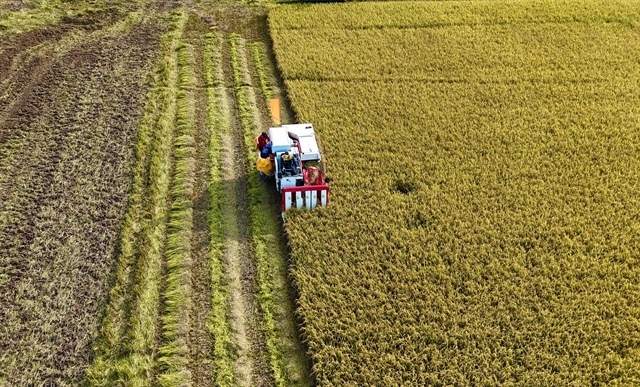
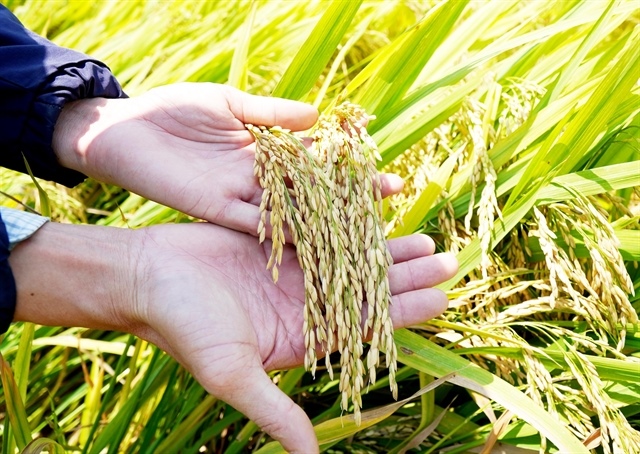
Farmers in the Mekong Delta province of An Giang harvest rice grown under the project 'Sustainable Development of One Million Hectares of High-Quality, Low-Emission Rice Associated with Green Growth in the Mekong Delta by 2030.' — VNA/VNS Photo |
Facing abundant global supply, high inventories in importing markets and mounting pressure from the upcoming Winter–Spring rice crop harvest, Việt Nam’s rice sector is accelerating its shift toward high-quality exports in order to sustain growth and enhance value.
Although export performance showed positive signs at the start of the year, the broader outlook remains challenging.
According to the Ministry of Agriculture and Environment (MAE), an estimated 600,000 tonnes of rice worth US$370 million was exported in January, up 12.4 per cent in volume and 16.9 per cent in value year-on-year. The average export price reached $616.6 per tonne, up four per cent.
Despite the encouraging start, the MAE warned that rice exports would face significant headwinds this year.
According to Đỗ Hà Nam, chairman of the Vietnam Food Association (VFA), global supply remains plentiful, intensifying competition. The export target for this year has been adjusted to around 7 million tonnes, in line with the Government’s orientation under Decision 583 to gradually reduce export volume to 4 million tonnes by 2030. The strategy reflects a structural shift from prioritising quantity to prioritising value.
In the short term, as the Winter–Spring rice crop is in progress, the risk of a sharp drop in paddy prices remains if timely financial solutions are not implemented.
From a business perspective, the Đại Đoàn Kết (Great National Unity) newspaper quoted Nguyễn Văn Thành, director of Phước Thành IV Trading–Production Co Ltd in Vĩnh Long Province, as saying that last year was already difficult for the rice sector and this year has yet to show clear improvement.
Export contracts are less abundant than in previous years because inventories in many importing countries remain high.
With substantial reserves still available, importers are reluctant to sign large contracts and instead place small, exploratory orders, keeping prices subdued.
Companies holding inventory from earlier purchases can still manage sales, but buying new stock at this stage offers minimal profit margins.
Market pressures
The Philippines, traditionally a key market for Vietnamese rice, has resumed purchases but mainly through small-volume contracts at relatively low prices.
Meanwhile, both domestic and international inventories remain elevated just as the Winter–Spring harvest accelerates, making market pressure difficult to avoid.
The MAE reports that total rice cultivation area nationwide is estimated at 7.09 million hectares this year, down more than 36,000 hectares compared to last year.
However, improved average yields of 6.14 tonnes per hectare are expected to lift total output to 43.55 million tonnes, slightly higher year-on-year. This reflects a consistent policy of reducing acreage while improving productivity and quality.
Amid forecasts of continued market volatility this year, the export structure is expected to further shift toward high-quality and fragrant rice.
High-quality and fragrant rice exports are projected to reach around 5.8 million tonnes, accounting for around 75 per cent of total export volume. Glutinous rice is expected to account for about 773,000 tonnes (10 per cent), while the remaining 15 per cent will consist of rice for processing purposes.
Instead of competing directly in the lower-priced white rice segment, typically valued at $300–350 per tonne, Việt Nam is repositioning itself in higher-value fragrant and specialty rice categories that face less intense competition and offer better margins.
Agricultural expert Hoàng Trọng Thủy described this as a "reverse positioning" strategy, focusing on quality rather than volume to penetrate premium and more sustainable market segments.
In fact, Việt Nam is among the pioneers in implementing large-scale low-emission rice production. According to the MAE, high-quality rice now accounts for around 89 per cent of total exports, of which 60–70 per cent comprises fragrant and specialty rice.
Quality-driven exports
Brands such as ST24 and ST25 are steadily strengthening their presence in demanding markets including the EU, the US and Japan.
Experts emphasise that alongside upgrading product quality, diversifying export markets is essential, particularly in underexploited markets such as Europe and the US.
Stronger participation from financially capable enterprises is also needed to purchase paddy and help stabilise the domestic market during peak harvest periods.
Trần Thanh Hải, deputy director of the Agency for Foreign Trade under the Ministry of Industry and Trade, said the ministry would continue refining the regulatory framework for rice exports, coordinate with the MAE to monitor output and support farmers, and accelerate trade negotiations and implementation of existing agreements.
Maximising preferential treatment under free trade agreements, including those with the EU and the UK, while unlocking new potential markets, would be crucial to sustaining export growth in an increasingly competitive global environment, he noted.
- 10:03 07/03/2026