HCM City set to get billion-dollar FDI projects in digital infrastructure
HCM City set to get billion-dollar FDI projects in digital infrastructure
The inflow of high-quality capital is expected to underpin the city's new growth drivers and bolster its long-term competitiveness.
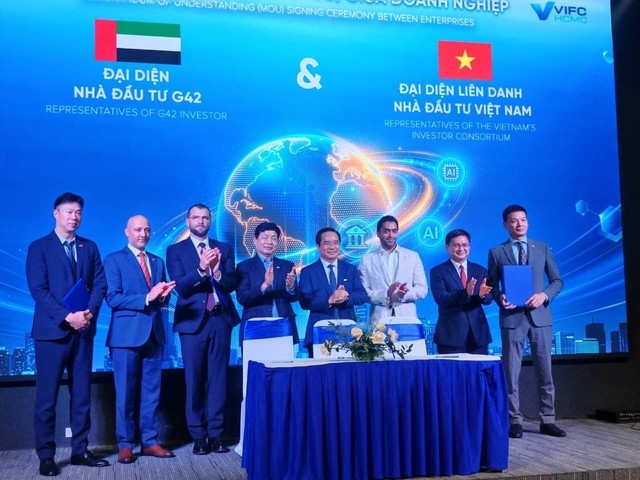
G42 and its Vietnamese partners sign a framework investment cooperation agreement in HCM City on February 8. — Photo baophapluat.vn |
HCM City is recording major shifts in the structure of foreign direct investment, with the emergence of large data centres and digital infrastructure and fintech projects signalling a new phase in its development trajectory.
The inflow of high-quality capital is expected to underpin its new growth drivers and bolster its long-term competitiveness.
A key highlight is the long-term framework agreement recently signed between Abu Dhabi-based G42, a leading technology group from the United Arab Emirates, and a consortium of domestic partners.
The agreement sets out plans to develop large-scale data centre infrastructure in Việt Nam, with total projected investment estimated at up to US$2 billion.
Under the arrangement, the parties plan to jointly invest in, build and operate international-standard data centres in the city, intended to serve as a critical platform for digital services catering to government agencies, businesses and international partners.
Alongside investment from the UAE, city authorities have also disclosed progress on another $2 billion data centre project backed by a US investor.
Speaking at the city’s socio-economic review meeting recently, Nguyễn Văn Được, chairman of the city's People’s Committee (municipal government), revealed that the investor had committed to disbursing 60 per cent of the capital, equivalent to $1.2 billion, as early as the second quarter of 2026.
“This is a strong indication that FDI flows into the city will become increasingly vibrant in the coming period, providing an important basis for the city to pursue double-digit economic growth,” Được said.
Data centre push
The development of large-scale data centres is expected to create a solid foundation for secure data storage, processing and transmission.
More importantly, analysts note that such infrastructure has become a prerequisite for attracting international financial institutions, fintech firms and global technology corporations.
This role has gained additional significance following the official launch of the Việt Nam International Financial Centre in HCM City (VIFC-HCMC) on February 11.
In modern financial systems, data is widely regarded as a core strategic asset.
According to Phạm Tuấn Anh, head of technology at the VIFC-HCMC Executive Agency, the centre will prioritise investment in advanced technological infrastructure to position itself as a “financial transit hub” for global capital flows.
“VIFC-HCMC is designed not only to serve investment flows into Việt Nam but also to evolve into a regional capital intermediary," Anh said.
“It will function as a buffer zone for FDI and especially foreign indirect investment (FII), which previously lacked sufficiently favourable mechanisms to enter Việt Nam.”
Such a mechanism is considered particularly meaningful as Việt Nam seeks to attract higher-quality capital.
Rather than focusing solely on manufacturing-oriented FDI, the city is increasingly targeting investment in sectors capable of generating higher value-added returns.
On its inaugural day, VIFC-HCMC drew strong interest from international investors. Among the highlights was a commitment by Vantage Point Asset Management, a major asset management firm operating in Singapore and Australia, to mobilise up to $10 billion over the next five years for investment through the centre.
The firm indicated that its investment focus would centre on data infrastructure, fintech platforms and smart urban systems.
Meanwhile, city authorities are advancing plans for the city’s Digital Assets Investment Fund, targeting a scale of roughly $1 billion.
Digital finance
The initiative is intended to support the development of the digital finance ecosystem and emerging fintech platforms.
VIFC-HCMC is also expanding into specialised segments, including an Asia-Pacific Aviation Finance Centre and a Maritime Finance Centre, aimed at serving industries with annual market values reaching hundreds of billions of US dollars.
G42 and its Vietnamese partners sign a framework investment cooperation agreement in HCM City on February 8. — Photo baophapluat.vn |
Behind the successive announcements of major digital infrastructure projects lies a deeper structural trend: a qualitative transformation of FDI flows into HCM City.
While earlier decades saw the city attract strong inflows of manufacturing investment driven by labour costs and geographic advantages, the current wave of capital is increasingly directed towards sectors requiring advanced technical infrastructure, a stable energy supply, and transparent regulatory frameworks.
This shift suggests that the city’s competitive advantages are evolving — from cost-based factors to infrastructure quality and its role within the digital economy.
According to Lâm Đình Thắng, director of the city's Department of Science and Technology, the city is entering a new development phase in which digital infrastructure plays a central role.
“The expansion of large-scale data centres, artificial intelligence and cloud computing will not only accelerate digital transformation but also serve as a key enabler for building a smart city and supporting the Việt Nam International Financial Centre,” Thắng said.
Aggregate data continues to underscore the city’s appeal to international investors.
It is home to more than 20,470 foreign-invested projects, with total registered capital exceeding $142.2 billion, according to the city's Department of Finance.
In 2025, it attracted over $8.37 billion worth of FDI, maintaining its position as the country’s leading destination for foreign investment.
Infrastructure expansion
The increasing concentration of investment in technology-intensive and high value-added sectors capable of generating strong spillover effects aligns with HCM City’s long-term development strategy, under which it aims to regain double-digit economic growth from 2026 and ultimately emerge as an international mega-city by 2045.
Alongside technology and finance, the city is calling for investment in a series of major infrastructure projects, including the Cần Giờ International Transhipment Port, the Cái Mép Hạ Free Trade Zone, strategic regional rail links, and a metro network expected to span around 350 kilometres.
In the energy sector, the city is promoting eight offshore wind power projects with a combined capacity of approximately 15,000 MW, LNG power initiatives and large-scale industrial developments.
Such projects are expected to not only meet the rising energy demands of the digital economy but also to help the city comply with sustainability standards increasingly prioritised by global investors.
Experts caution that while large-scale digital infrastructure projects require time to materialise and deliver full economic benefits, their emergence reflects growing investor confidence in the city’s role in the region’s digital and financial ecosystem.
At the same time, technology-intensive investments impose higher demands on electricity infrastructure, energy stability and regulatory clarity.
To address these challenges, city authorities are stepping up efforts to improve the investment climate, upgrade infrastructure and develop human resources.
These measures, according to policymakers, will be essential in enhancing the city’s capacity to attract and effectively utilise high-quality FDI amid intensifying regional competition.
- 09:02 07/03/2026