Price management will be challenging this year, says deputy PM
Price management will be challenging this year, says deputy PM
Under the first scenario, the average consumer price index (CPI) would rise by about 3.6 per cent compared to 2025. The second scenario projects an increase of around 4.1 per cent, while the third estimates a rise of roughly 4.6 per cent year-on-year.
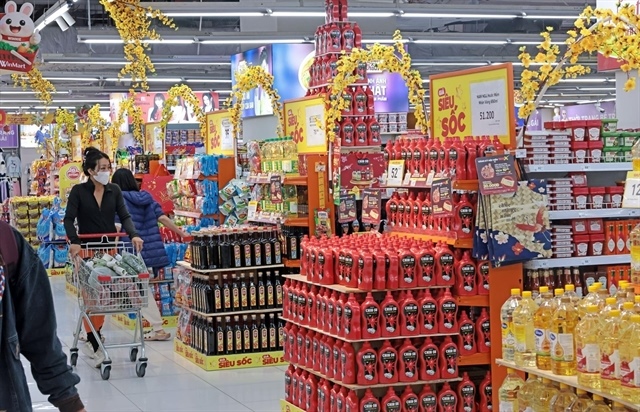
Shoppers at a supermarket in Hà Nội during the Tết holiday. — VNA/VNS Trần Việt |
Deputy Prime Minister Hồ Đức Phớc has said that price management in 2026 must safeguard macro-economic stability while supporting meaningful economic expansion, cautioning against a situation in which growth is accompanied by surging inflation and rising living costs.
Chairing a meeting on February 26 on price management for 2026, Phớc said the objective of achieving double-digit growth must be aligned with strict inflation control to protect people’s livelihoods. Growth, he stressed, must translate into real improvements in living standards rather than being offset by higher prices.
Reviewing 2025, he noted that price management had delivered positive results despite significant global and domestic challenges, contributing to macro-economic stability and inflation control. Lessons drawn from last year would serve as a basis for more focused, flexible and effective management this year.
The Ministry of Finance reported that several factors could put upward pressure on prices in 2026. These include fluctuations in global commodity markets, higher import costs for raw materials, rising construction material prices and pork prices, as well as adjustments to State-managed goods and services.
Domestic factors such as consumption stimulus measures, lower lending rates, credit expansion and accelerated public investment may also add to inflationary risks. Climate change and extreme weather events remain additional uncertainties affecting supply and prices.
However, the ministry pointed to a number of mitigating factors. Global inflation is showing signs of easing, while domestic food supply is expected to remain stable. Continued coordination between fiscal and monetary policies, along with the Government’s consistent focus on macro-economic stability in recent years, will likely help anchor inflation expectations among businesses and consumers.
Based on current assessments, the ministry outlined three inflation scenarios for 2026. Under the first scenario, the average consumer price index would rise by about 3.6 per cent compared to 2025. The second scenario projects an increase of around 4.1 per cent, while the third estimates a rise of roughly 4.6 per cent year-on-year.
To manage price pressures, authorities will closely monitor global economic and inflation trends, including policy adjustments in major economies and key trading partners. Domestic market developments will also be supervised to ensure timely responses.
Ensuring a balance between supply and demand, particularly for essential goods such as food, fuel and electricity, will remain a priority. Ministries and localities are tasked with preparing contingency plans to prevent shortages and sudden price spikes, especially in the event of natural disasters or supply chain disruptions.
Fiscal policy will continue to be coordinated closely with monetary and other macro-economic policies to maintain major economic balances. Agencies are also required to proactively update inflation forecasts and prepare pricing plans for State-managed goods and services in line with market principles.
Phớc called for the flexible and effective use of price management tools in accordance with the Law on Prices, alongside strengthened inspection and supervision to prevent speculation, hoarding and price manipulation. Transparency in information on price management and market developments should also be enhanced to reinforce public confidence.
Warning that 2026 could present considerable challenges, the deputy PM urged ministries, sectors and localities to act decisively and in close coordination to keep inflation under control, maintain macro-economic stability and support sustainable growth that benefits the public.
- 16:48 26/02/2026