Opportunities to reposition Việt Nam’s electronics enterprises
Opportunities to reposition Việt Nam’s electronics enterprises
For many years, Vietnamese electronics enterprises have mainly participated in global supply chains based on cost advantages and order-fulfillment capacity. However, this model is facing increasing pressure as major markets simultaneously tighten ESG requirements.
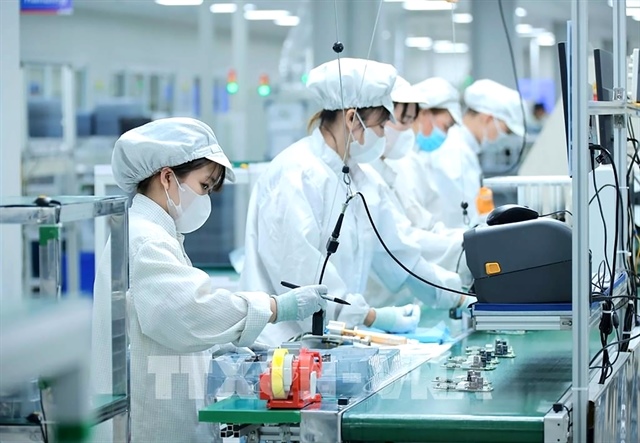
Bumjim Electronics Vina factory, a 100 percent Korean-owned enterprise, in Quảng Ninh Province. — VNA/VNS Photo |
As global trade rules tighten, environmental social and governance (ESG) standards are becoming a mandatory passport for Vietnamese electronics enterprises seeking a place in international supply chains, turning compliance into both a test and an opportunity for the industry.
Meeting these new standards poses major challenges, but it also opens pathways for domestic companies to reposition their competitive strengths and gradually move up the value chain.
For many years, Vietnamese electronics enterprises have participated in global supply chains largely on cost advantages and order fulfilment capacity.
That model is now under growing strain as major markets simultaneously tighten ESG requirements.
Đỗ Thị Thúy Hương, a member of the executive committee of the Việt Nam Electronic Industries Association (VEIA), said ESG had become a cross-cutting requirement across the entire operational chain, particularly for electronics and high-technology firms.
Compliance with environmental labour governance and information transparency standards was no longer voluntary but a mandatory condition for participating in global supply chains or exporting to international markets, she said.
The VEIA identifies 2025–2027 as a pivotal phase, during which enterprises exporting to Europe must strictly comply with ESG standards, including net-zero emissions roadmaps labour standards corporate governance and transparency requirements.
As one of Việt Nam’s strategic export industries, the electronics sector is being directly and strongly affected by this transition.
Phạm Thị Ngọc Thùy, director of the advisory council for private economic development, noted that enterprises embedded in export supply chains were the most directly affected by ESG requirements, while companies mainly serving the domestic market faced a lower level of impact.
Even so, amid rapidly shifting global and domestic policies, enterprises could not stand outside international trends if they wanted sustainable development and market expansion in the medium and long term, she said.
In Việt Nam, the legal framework for environmental protection and sustainable development is also being completed at pace.
The net-zero emissions target is not only an international commitment of the Vietnamese Government but is also underscored in key Politburo resolutions, creating clear pressure for transformation across the business community.
From practical ESG implementation, a major current bottleneck lies in corporate awareness. Many enterprises believe the greatest difficulties stem from shortages of capital technology or information.
Experts argue, however, that if ESG is treated merely as an add-on alongside core business operations, substantive change is unlikely.
Only when ESG is embedded in core strategy and becomes part of the business model can transformation be carried through successfully, experts said.
Trần Đức Tùng, deputy general director of Hanel PT JSC, said ESG implementation required significant investment, particularly in renewable energy systems, environmental control and data governance.
In the short term, such investments may not yield clear financial returns, but in the long run ESG should be seen as an investment in governance capacity and competitiveness, helping enterprises strengthen internal capabilities streamline systems improve productivity and sustain competitive advantages, he said.
At the industry level, the VEIA has submitted a proposal to the Ministry of Industry and Trade to develop ESG guidelines tailored to the practical conditions of domestic electronics enterprises.
At the same time, the association is rolling out specialised ESG human resource training programmes and working with international organisations to help firms access and meet new standards.
ESG can only be implemented effectively with the support of professional organisations supply chain connectivity and close cooperation among enterprises.
As the world moves towards sustainability, ESG has become a litmus test of corporate governance capacity and resilience.
Vietnamese electronics enterprises can reposition successfully only by treating ESG as the foundation of a long-term strategy, enabling a shift from low-cost suppliers to value-added partners in global supply chains.
- 08:00 05/02/2026