New food safety rules halted as container backlog builds at ports
New food safety rules halted as container backlog builds at ports
The government has paused new food safety rules until April 2026 after confusion over their immediate enforcement brought import procedures to a halt and clogged major ports, including HCM City’s Cát Lái.
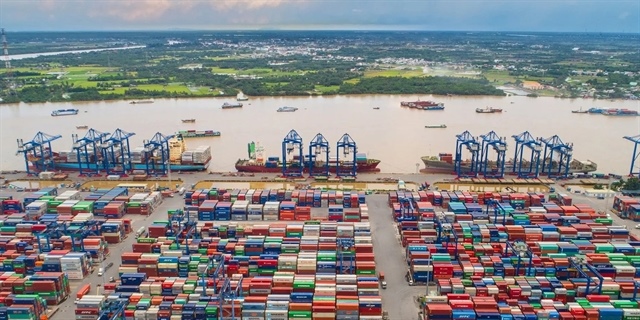
Containers backlogged at Cát Lái Port after Decree 46 took effect. — Photo tienphong.vn |
The Government has put two newly enacted food safety regulations on hold after their abrupt rollout caused widespread disruption at ports and border crossings, leaving thousands of containers stranded and importers unable to clear goods.
The Government said it would temporarily suspend Decree 46, which details enforcement of the Food Safety Law, along with Resolution 66.13 on food product declaration and registration.
Both measures took effect in late January and will now be paused until April 15, before being reinstated the following day.
Until then, authorities will revert to previous rules under Decree 15, which has governed food safety procedures since 2018.
The reversal follows mounting complaints from businesses after Decree 46 came into force immediately on January 26, without a transition period or clear guidance on how new inspection requirements would apply to imported goods.
Since the end of last week, thousands of containers have been held at seaports and border gates. At HCM City’s Cát Lái Port, more than 1,800 containers remained stranded as of February 4, according to customs officials.
Importers and logistics firms said confusion over the new rules left companies and frontline officials unsure how shipments should be processed, effectively bringing clearance procedures to a halt.
Vũ Kim Hạnh, chairwoman of the Association of High-Quality Vietnamese Products, said one of the main sticking points lies in food safety certification requirements.
Under Decree 46, companies are still required to obtain certificates issued by Vietnamese authorities confirming their products meet food safety conditions, even when those products already comply with internationally recognised standards.
Hạnh said this added costs, slowed paperwork and delayed shipments at a time when transport and financing expenses are already high.
She said the rationale for requiring additional domestic certification needs reconsideration, particularly given that the same international standards allow Vietnamese exports to enter major overseas markets.
Another concern raised by businesses is the requirement that food safety test results follow a Việt Nam-specific format.
Industry groups said this effectively limits acceptance of results from international testing laboratories, even when those labs are legally operating in the country.
Phạm Khánh Phong Lan, director of HCM City’s Food Safety Authority, said food importers were placed under severe pressure by the decree’s immediate enforcement, which left no time to adapt.
She warned the regulation risks focusing enforcement efforts in the wrong areas.
While Decree 46 tightens controls on self-declared food products, typically everyday consumer goods, other categories with a history of safety violations, such as health supplements, functional foods and milk products, have not been subject to tougher oversight.
“Food safety is not improved by making licensing more complicated,” Lan said.
“That only creates friction and opportunities for abuse. What matters is strong post-inspection, clear responsibilities and effective enforcement.”
At a regular government meeting on February 4, Prime Minister Phạm Minh Chính ordered ministries to swiftly draft a new resolution to address problems caused by Decree 46, saying the disruption could not be allowed to continue.
He also cautioned agencies against abrupt policy changes, stressing that new regulations should include clear transition periods to avoid sudden shocks to businesses and supply chains.
- 16:27 05/02/2026