Market diversification crucial for VN's robust growth: UOB
Market diversification crucial for VN's robust growth: UOB
UOB recently raised its 2025 GDP growth forecast for Việt Nam to 7.7 per cent, close to the Government’s 8 per cent target. The revision reflects robust results in the first three quarters of 2025, particularly in manufacturing and exports, placing Việt Nam among the fastest-growing economies in ASEAN.
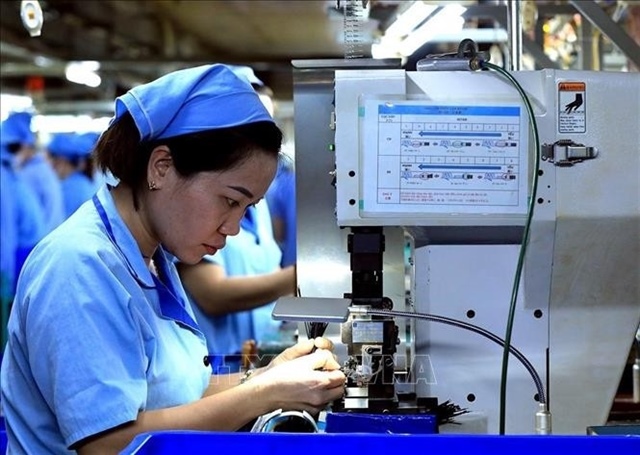
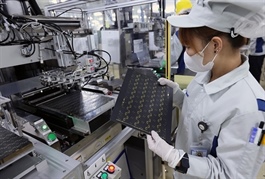
A semiconductor production line at the Left Bank of the Da River Industrial Zone. — VNA/VNS Photo |
Although Việt Nam has recorded strong economic performance in 2025, the country should adopt a more cautious stance in 2026, with a focus on infrastructure investment, productivity gains and market diversification to retain its position as one of Southeast Asia’s fastest-growing economies, according to Suan Teck Kin, Executive Director of Global Economics and Markets Research at Singapore-based United Overseas Bank (UOB).
UOB recently raised its 2025 GDP growth forecast for Việt Nam to 7.7 per cent, close to the Government’s 8 per cent target. According to Kin, the revision reflects robust results in the first three quarters of 2025, particularly in manufacturing and exports, placing the country among the fastest-growing economies in ASEAN.
Manufacturing continues to be a key engine, helping the country strengthen its role in regional supply chains. Together, strong exports, improved domestic consumption, a tourism rebound and accelerated public investment underpin UOB’s upgraded growth outlook for 2025, despite expectations of a slight slowdown in the fourth quarter compared with the earlier quarters.
Kin noted that intensified US–China tensions in 2025 have created both opportunities and challenges for the country. On the positive side, supply chain relocation has benefited Việt Nam, with exports to the US surging. The US now accounts for about 30 per cent of Việt Nam's total exports, making it the country’s largest market.
The UOB expert noted that foreign direct investment has also exceeded expectations, with disbursed FDI reaching around US$23.6 billion in the first 11 months of 2025, reflecting investor confidence in the country's location, labour force and business-friendly policies.
However, Việt Nam high dependence on exports, equivalent to about 83 per cent of GDP, also heightens vulnerability to a global slowdown, particularly in US demand. Sector-specific tariff risks, especially for furniture and wood products, and labour market pressures from rising wages without commensurate productivity gains, could affect competitiveness and inflation.
UOB forecasts GDP growth at around 7 per cent in 2026, lower than in 2025 but still the strongest in the region. Kin said a moderate slowdown will help ensure sustainable growth and prevent rising costs.
Infrastructure investment should remain the top priority, spanning transport, ports, logistics, digital infrastructure, education and training to reduce costs and boost productivity. Improving human capital is also critical, ensuring wage growth is matched by productivity gains through skills development, digital transformation, and education improvement.
In addition, greater attention should be paid to social housing, health care and welfare to lower living costs and enhance long-term competitiveness. Finally, both the Government and businesses should accelerate market and product diversification, reducing reliance on electronics and the US market by expanding into Southeast Asia, the Middle East, Africa, Latin America and Eastern Europe, thereby strengthening resilience against global shocks, Kin concluded.
- 07:31 23/12/2025