Draft decree on 2 per cent rate subsidy for green projects to be submitted this week
Draft decree on 2 per cent rate subsidy for green projects to be submitted this week
The State Bank of Việt Nam (SBV) is finalising a draft decree guiding the provision of 2 per cent annual interest rate subsidies for loans financing projects that comply with green, circular economy and environmental, social and governance (ESG) requirements. The draft will be submitted to the Government this week for revision, an official said at a conference on Monday in Hà Nội.
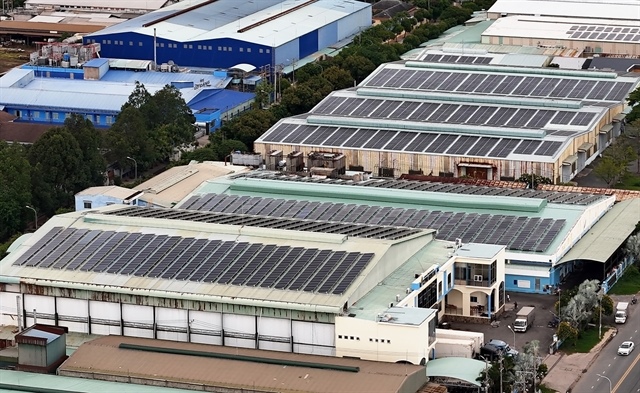
Factories installed with rooftop solar panels in Đồng Tháp Province. A draft decree on 2 per cent rate subsidy for green projects will be submitted to the Government for revision this week. — VNA/VNS Photo Hồng Đạt |
The State Bank of Vietnam (SBV) is finalising a draft decree guiding the provision of a 2 per cent annual interest rate subsidy for loans financing projects that comply with green, circular economy and environmental, social and governance (ESG) requirements.
The draft will be submitted to the Government this week for revision, an official said at a conference on diversifying capital for sustainable development that was held by the Finance and Investment newspaper on Monday in Hà Nội.
At the conference, Phạm Thị Thanh Tùng, deputy director general of the SBV’s Department of Credit for Economic Sectors said that if approved, the decree will take effect as soon as early next year.
The mechanism follows the Politburo’s Resolution 68 on private sector development and the National Assembly’s Resolution 198 introducing a mechanism to provide a 2 per cent annual interest rate subsidy for private businesses to implement green, circular economy or ESG-compliant projects through the Small and Medium Enterprise (SME) Development Fund and commercial banks.
Tùng said that unlike previous years, when commercial banks relied mainly on their own resources to offer preferential green loans, the new mechanism would mobilise additional support from the State budget, which will increase access to concessional capital and encourage businesses to transform toward more sustainable business models.
She cited statistics showing that over the past five years, green credit in Việt Nam has grown at an average rate of 21 per cent per year, outpacing overall credit growth. The number of credit institutions reporting green loan portfolios has risen from 15 in 2017 to 58 at present.
Tùng said that to further accelerate green lending, the Ministry of Agriculture and Environment needs to issue more detailed regulations on green taxonomy and green washing.
She also stressed the importance of developing a national database of approved green projects to facilitate green credit and ensure transparency.
Deputy Director of the Ministry of Finance’s Department of Financial Institutions Phạm Thị Thanh Tâm said separately that a decree on the 2 per cent interest rate subsidy channelled through the SME fund would be submitted to the Government later this month.
She said that as of October, outstanding green corporate bonds stood at nearly US$1 billion, a positive sign that companies have begun to proactively seek long-term funding from the capital market rather than relying solely on bank loans.
The Ministry of Finance is also studying a pilot scheme for issuing green service bonds, which is expected to be submitted to the Government in 2026, she added.
Vương Văn Quý, deputy head of Agribank’s credit policy department, urged the Government to quickly establish a national emissions database and standardise greenhouse gas measurement regulations to provide banks with a more solid ground for accurate risk assessment.
According to SBV Deputy Governor Nguyễn Ngọc Cảnh, the banking sector has played a central role in financing the green transition, with outstanding green credit reaching about VNĐ750 trillion ($28.5 billion) as of the end of November, expanding at more than 21 per cent per year since 2017.
However, relying solely on bank credit would put heavy pressure on the financial system, as Việt Nam’s net zero goal is estimated to require huge financial resources.
The finance ministry estimated that Việt Nam needs $670-700 billion for green and sustainable economy development by 2050.
“Việt Nam must diversify funding sources, especially by mobilising private capital, developing the capital market and attracting international finance, to meet the capital demand for green growth targets,” Cảnh said, adding that this would help provide longer-term, more flexible funding for sustainable development.
Experts at the conference also stressed that it will be critical to complete emissions data infrastructure, strengthen ESG capacity, unlock bond markets and roll out interest rate support schemes.
The combination of banking credit and private capital markets is essential for Việt Nam to effectively address the country’s sustainable development funding needs.
- 07:56 16/12/2025